The Real Differences in Materials and Craftsmanship Between Cigars of Different Price Levels
In the autumn of 2023, I stood for nearly forty minutes in front of a wooden cabinet at a cigar bar in Shanghai. The clerk placed two similarly sized Robustos side by side on a tray: a domestic/New World entry-level handmade long filler, priced at about 45 yuan that day; and a limited-number Nicaraguan flagship line, priced at just over 280 yuan. Both looked "quite good," both wrappers were dark brown, and both labels read "all handmade" and "aged tobacco." If you only listened to the sales pitch, you'd think the expensive one must crush the cheap one "in every leaf."
I later smoked both — the cheap one right there at the bar, the expensive one I took home and let rest in a 65%–68% RH humidor for two weeks before opening. The conclusion was disappointing, but useful: **The expensive cigar didn't crush the cheap one in "every puff being more aromatic," but it was noticeably more stable in combustion consistency, impurity control, wrapper integrity, and the transition from cold to warm.** The cheap one's first half was actually decent, but the last third started to get slightly hot and hollow, and the foot ash fell apart at the slightest touch. In the price difference, there's real substance, but also storytelling.
This article has a very specific mission: to break down **what high-priced and low-priced cigars really differ in** — materials, craftsmanship, time, waste, labor, brand, and distribution channels — helping you avoid being led astray by terms like "limited edition," "black leaf," "ten-year aging," and "Cuban heritage." Let me first state my position: cigars are tobacco products, and price levels do not rewrite health risks; what follows is about **sensory and craft economics**, not health rankings.
I. What Actually Builds Up the Price of a Cigar
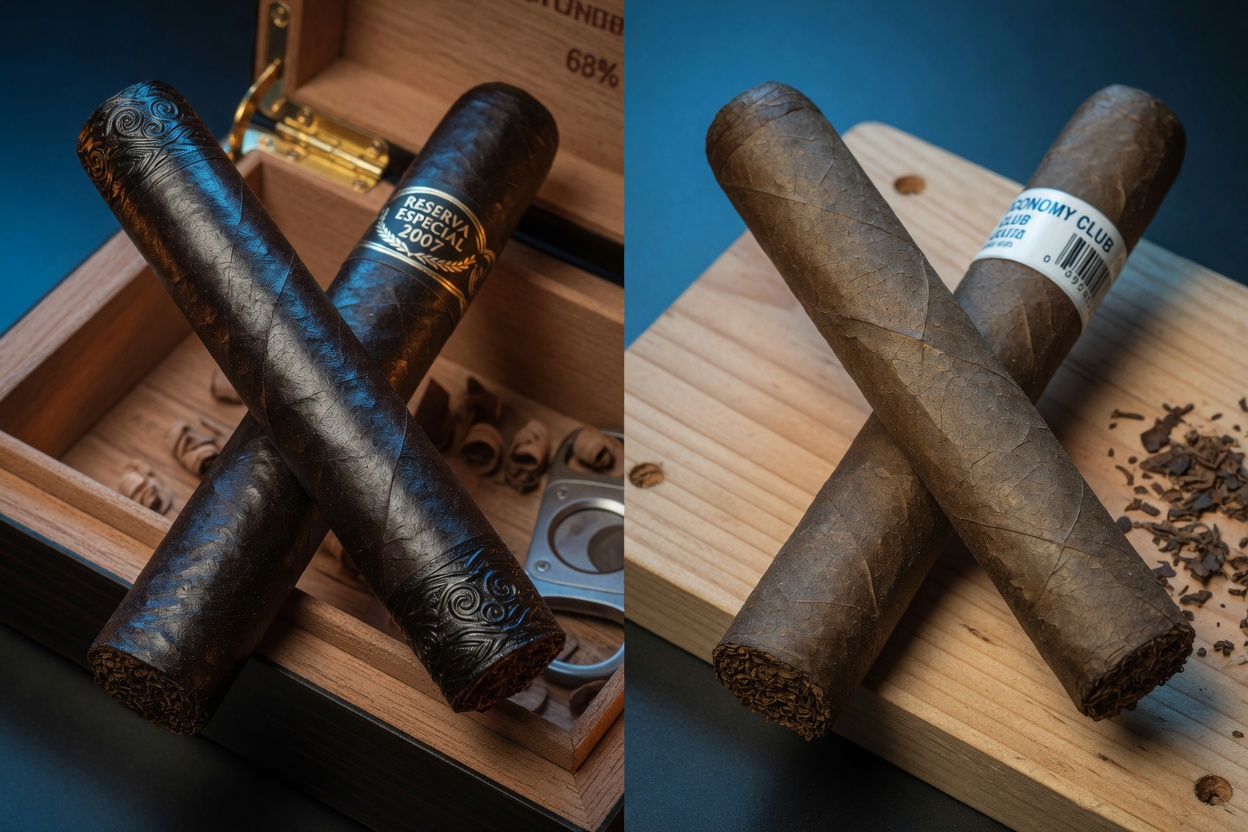
On the open market, you can find machine-rolled/short-filler cigars for a few euros each, as well as collectible cigars costing hundreds or even thousands of euros. The price gap is extreme, but the underlying accounting is not mysterious:
| Cost Component | What It Roughly Does | Impact on Selling Price |
|---|---|---|
| **Wrapper** | Appearance, first layer of combustion, part of the aroma; lowest pass rate | Often the largest single item on the raw material side |
| **Filler** | Main taste and strength; multi-position long filler blend | Medium-high; formulation complexity raises cost |
| **Binder** | Holds the filler together, affects airflow and combustion | Medium, often overlooked |
| **Fermentation & Aging** | Occupies storage, capital, and time | Highly sensitive in premium lines |
| **Hand Rolling** | Sorting, bunching, wrapping, pressing, quality inspection | High proportion in long-filler handmade |
| **Waste** | Damaged leaves, inspection rejection, draw defects | The stricter the wrapper selection, the higher the waste |
| **Brand & Distribution** | Storytelling, taxes, import, retail margins | May exceed the actual raw material difference |
During a factory tour in the Estelí region of Nicaragua in 2022, the guide pointed at the drying barns and sorting tables and said a very straightforward thing: **"Half of what the guest pays may be going to 'the leaves that are left over after sorting' and 'the time the master sits there not making mistakes.'"** Not entirely precise, but the direction is right.
Let me put my personal view here first:
**Price buys "a higher probability of consistency + more scarce appearance and aging inventory," not "definitely more to your taste."**
Mid-priced, well-blended handmade long fillers are often more suitable for daily judgment than extremely high-priced collectible products.
2. Differences in materials used: The most expensive thing is often “the piece that can be used”
1. The Wrapper: Most Expensive, Most Selective, Most Easily Exaggerated by Marketing
A cigar is composed of three layers: **wrapper, binder, and filler**. The wrapper is the visible outer leaf, requiring thinness with toughness, uniform color, appropriate oil content, and minimal bug holes and damage. On the same tobacco plant, the proportion of leaves that reach wrapper standard is already low; after curing, fermentation, and sorting, **the wrapper that actually ends up on retail cigars is often a very small fraction of the entire batch.**
Common process descriptions note: wrapper upfront costs are significantly higher than filler and binder, because selection, drying, and fermentation are more time-consuming, and qualified output is fewer. Shade-grown wrapper pursues delicacy and uniform color, requiring higher investment; leaves grown in stronger sunlight tend to be thicker, with different oil content and strength, leading to different uses and price structures.
I've developed a habit during comparative tasting: **Look at the wrapper first, then feel the elasticity, and only last listen to the origin story.**
A common misconception: **"The darker the wrapper, the better/more expensive."**
Darker color often correlates with longer or more intense fermentation, thicker leaves, and higher oil content, resulting in flavors leaning toward sweet cocoa, roasted, and earthy notes — but not everyone likes them, and it doesn't mean more stable combustion. Color is one result of the process, not a quality score.
2. Filler: long core, short core, broken leaves - the "meat" of the price difference
**Long filler** uses whole or large sections of leaves arranged longitudinally, burning slower and making flavor layers easier to achieve, but requiring high draw control from the buncher.
**Short filler** mostly uses scraps and offcuts, low cost, suitable for machine rolling and entry-level pricing, burning fast with more direct and "punchy" aromas, with stability relying on blend and cut uniformity.
Also says "Handmade", the inside might be:
At an industry exchange in Guangzhou in winter 2021, a friend working in import wholesale gave a rough calculation (he emphasized it was "order-of-magnitude feel," not an audit report): at the same size, **from short-filler machine-rolled to entry-level long filler, raw material + labor may differ by an order of magnitude in "starting price"; from entry-level long filler to flagship blend, adding wrapper grade and aging stock, the selling price can multiply several times over.** The 30 yuan, 80 yuan, and 200 yuan that consumers see on shelves often represent different species, not "the same product plus a tax."
3. The Binder: The Underestimated Middle Layer
The binder binds the filler core, affecting the suction resistance and burning skeleton. A good binder must have toughness and suitable flammability; a poor binder will cause "collapse in the middle, blockage of the air path, and burning and extinguishing at the same time." Low-priced products sometimes use barely qualified leaves as the wrapper, and the appearance is entirely covered by the wrapper; high-priced products also have stricter sorting on the wrappers—but they don’t like to talk about it in advertisements because they don’t look good in photos.
4. Origin Labels Don't Automatically Mean Top Quality
Cuba's Vuelta Abajo microclimate, the Dominican Republic's classic blending traditions, Nicaragua's power and New World innovation — these are real differences. But **"Made in X country" is just an origin coordinate system, not a score.** Within the same country, from farm plot to yearly climate, fermentation management to factory QC, variance can be huge. I prefer to understand origins as a "flavor map of ingredients," not an "automatic price-increase license."
III. Process Differences: Time, Craftsmanship, and Quality Standards
1. Fermentation and aging: the money is in “waiting”
After cigar tobacco leaves are fielded and cured, they usually undergo accumulation fermentation (in the form of Pilón, etc.) and storage aging. Public information and industry common sense are roughly on this scale:
Low-price lines need fast turnover and can't afford aging stock; high-price lines have the luxury of "raising the leaves until they're usable." The "not harsh, not raw, it opens up" feeling in your mouth is often not magic, but **ammonia irritants and green impurities partially worn away by process time.**
But to pour cold water on this: **Aging is not an infinite bonus.** Overdry, overwet, or improperly sealed "fake aging" only yields flat, collapsed cigars or mold risk. When the box says "ten years," ask: is it the whole blend, some of the filler, or just the marketing calendar?
2. Sorting: The Invisible Assembly Line Cost
One of the most expensive scenes in the factory is the sorting table: leaves are turned over under the light and piled according to color, damage, thickness, and parts. When I visited Esteli, people at the sorting stations hardly raised their heads to chat - when the speed slowed down, the entire rolling line was hungry for leaves.
**Half of the "good materials" of high-priced products are "throw away more". **
It’s not that low-priced products cannot be smoked, but they allow more “small defective leaves” to enter the binder or filler, and even the wrapper repair leaves. This will be reflected in the empty feeling in the second half of the draw, local off-track burning, loose ash content - not every time, but the probability is higher.
3. Rolling: Draw and Combustion Are Craft, Not Stickers
Key steps of full handmade long filler:
At a private gathering in Beijing in 2019, I tried two mid-priced cigars of the same brand and model but different batches side by side: one had perfect draw, one was tight. Same brand, same price, yet the experience was significantly different. This shows: **process variance is real; price only buys a "higher probability of stricter QC," not absolute zero variance.**
The advantage of machine-rolled and short filler is standardization and low cost; the downside is limited complexity and combustion quality ceiling. No need to disdain machine-rolled — if you just occasionally want tobacco flavor on a budget, machine-rolled gets the job done; just don't expect flagship handmade narratives from it.
4. Packaging and Moisturizing: Spend your money “before it gets to your mouth”
Cedar wood boxes, tubes, individual aluminum tubes, and hydration bags will all cost more. Part of it is protection (anti-breakage, moisture retardant), and part of it is ritual and gift attributes. My personal judgment:
IV. A Comparison Table: Where Low, Mid, and High Prices Typically Differ
Below is an empirical summary, not a national standard:
| Dimension | Low Price (Machine-rolled/Short-filler/Entry Handmade) | Mid-Price Handmade Long Filler | High Price/Flagship/Limited |
|---|---|---|---|
| Filling | Short filler or simple long filler | Complete long filler blend | Multi-position + longer aging stock |
| Wrapper | Usable is enough, higher defect probability | Relatively neat | Scarce color/top-tier sorting |
| Fermentation & Aging | Short, fast turnover | Reaches "coordination" | Longer stock, special aging narrative |
| Rolling & QC | Relaxed standards | Relatively stable | Stricter, higher waste |
| Experience | Direct, volatile | Good value, re-purchaseable | Consistency + scarcity, but not guaranteed to be more enjoyable |
| What You Pay For | Smokable tobacco | Process completeness | Scarcity + brand + distribution |
My own buying principles are very down-to-earth:
V. Marketing Rhetoric Check: Which Claims Should Be Taken with a Grain of Salt
**Hype Phrase 1: "Limited edition number = tastes better."**
Limited editions often correspond to special sizes, special wrapper colors, anniversary years, or channel exclusives. They may be better, or they may just be rarer. Limited guarantees **quantity narrative**, not your taste bud score.
**Hype Phrase 2: "Aged X years, so it's worth the price."**
It is necessary to ask whether the aging object is tobacco leaves or sticks, the entire filler or a little "finishing leaf". Time has a cost, but if the warehousing conditions are wrong, time is a negative asset.
**Hype Phrase 3: "Packaging and origin stickers determine quality."**
Origin is a flavor clue; the sticker is compliance and marketing. I've encountered mid-priced cigars with ordinary origins but solid blends and QC that trounced high-priced sticks with "great stories but crooked burns."
**Hype Phrase 4: "More expensive = healthier/fewer additives."**
Premium cigars typically emphasize whole-leaf rolling and minimal industrial flavoring (depending on category and regulatory claims), but this **does not equal low risk.** Burning plant leaves still produces complex smoke; price discussions should stay within sensory and craft territory, not slide into pseudo-health.
**Hype Phrase 5: "A famous brand never produces a bad stick."**
The average value of famous manufacturers is higher, but the variance is still there. Storage conditions (temperature, humidity, shipping exposure) can ruin a good cigar. In the summer of 2020, I had a high-priced tube that was suspected of being high in temperature during transportation. After opening, the wrapper oil was sticky and smelled stuffy. The problem lies in logistics and storage, not in your inability to smoke.
6. How to judge “whether the price difference is worth paying”: a set of operational on-site procedures
You can use this 15-minute process at the store or at home to reduce the risk of being swayed by sales talk:
In spring 2024, after adjusting my humidor humidity from about 72% down to the 66%–68% range, the "muted sweetness and uneven burn" of the same batch of mid-priced Nicaraguan cigars noticeably decreased — **experience differences caused by storage conditions are sometimes larger than price differences.** Many people think they bought fakes when actually their humidor ruined the cigars.
VII. Personal Conclusion: The Real Dividing Line Between High and Low Prices
If I could keep only three judgments:
**First, the really expensive materials are qualified wrapper + complete long-core formula + aging stock that can withstand pressure; ** not the hot stamping on the box.
**Secondly, what is really expensive in the process is the sorting loss, the master's air path control, the quality inspection elimination rate, and the time you are willing to wait;** It is not the word "purely handmade" itself - manual work will also produce defects.
**Third, what is really smart in consumption is to use mid-priced long-term products to establish your own taste coordinate system, and then pay a premium for scarcity and stability according to the occasion;** Don't be superstitious about expensiveness, nor should you assume that cheapness is a pitfall.
The gap between 45 yuan and 280 yuan on the same counter, when broken down, is often about: whether the leaves were sorted clean, whether fermentation and aging were completed, whether rolling underwent repeated inspections, and how much "story tax" the brand and import channel added. You can pay for the parts you care about, not the entire mythology.
Whether the leaves have been picked clean, whether the fermentation and aging have been completed, whether the rolling has been repeatedly inspected, and how much story tax has been added to the brand and import channel. Instead of paying for the whole myth, you can pay for the parts of it that you care about.
Finally, I must include this unpopular statement: **Regardless of price level, a cigar is tobacco; refined craftsmanship does not make the risk disappear.** If you're already on the path to reducing or quitting, using your "industry knowledge" to see through marketing and reduce wasteful spending is more cost-effective than chasing more expensive boxes.